Showing posts with label Pagan blog project. Show all posts

Friday, May 25, 2012

Kabir: The Snarky Ecstatic Saint Poet


Today's post is brought to you by the letter "K" in the Pagan blog project. :)

 Poetry plays a large part in my spiritual practice. Poetry is visceral. It is emotive. It connects us to our deeper selves, often bypassing the rational. The language of poetry reaches deeply into our being and our wild core. It taps into our sense of awe and connection. It challenges us to be fully present.

Poets seem to tap into universal truths and Mystery. This is especially true of poets whose inspiration is Mystery or the gods. Kabir is one of those poets. He is a 15th century mystic who lived in India. Although born to into a Muslim family, he became a student of the bhakti saint Ramananda. Like so many of us these days, Kabir lived in the real world, choosing not to live as an ascetic or guru which would have been customary for the time. Instead he married, had children, and earned his living as a weaver. He was also very irreverent and outspoken. I call him the snarky saint of India.

Philosophically, Kabir was a nirguna bhakti mystic, meaning that he believed that God could not be named, conceptualized or understood. That mystery is beyond our rational understanding. Instead God can be found in the ecstasy of life and living. He was suspicious of religious institutions and doctrines. God is not found in forms. God is found within and in those easy moments where we everything seems to flow with great connection.

It's not difficult to see why I am drawn to his poetry, and how it resonates with my own spiritual practice as an ecstatic witch.

Here are some poems. They are often short, more like meditations. None of the poems have names, so I've just used the first line of the poem as  it's name. The epithets at the end are short stand-alone stanzas. Note that Ram is Kabir's naming of God

Go Naked
Go naked if you want
put on animal skins
what does it matter till you see the inward Ram?

If the union yogis seek
Came from roaming about in the buff,
every deer in the forest would be saved.

If shaving your head
spelled spiritual success,
heaven would be filled with sheep.

And brother, if holding back your seed
Earned you a place in paradise,
eunuchs would be the first to arrive

Kabir says: Listen brother,
without the name of Ram
who has ever on the spirit's prize?

That Master Weaver
That master weaver, whose skills
   are beyond our knowing,
   has stretched his warp
      through the world.
He has fastened his loom
   between earth and sky,
   where the shuttlecocks are the sun
     and moon.
He fills the shuttle with the thread
   of easy spontaneity,
   and weaves and weaves
     an endless pattern.
But now, says Kabir, that weaver!
   He breaks apart his loom
   and tangles the thread
     in thread.

Pundit, How Can You Be So Dumb?
Pundit, how can you be so dumb?
You’re going to drown, along with all your kin,
     unless you start speaking of Ram.

Vedas, Puranas—why read them?
     It’s like loading an ass with sandalwood!
Unless you catch on and learn how Ram’s name goes,
    how will you reach the end of the road?

You slaughter living beings and call it religion:
     hey brother, what would irreligion be?
“Great Saint”—that’s how you love to greet each other:
     Who then would you call a murderer?

Your mind is blind. You’ve no knowledge of yourselves.
     Tell me, brother, how can you teach anyone else?
Wisdom is a thing you sell for worldly gain,
     so there goes your human birth—in vain.

You say: “It’s Narad’s command.”
     “It’s what Vyas says to do.”
     Go and ask Sukdev, the sage.”
Kabir says: you’d better go and lose yourself in Ram
     for without him, brother, you drown.


Tell me, O Swan,
Tell me, O Swan, your ancient tale.
From what land do you come, O Swan? to what shore will you fly?
Where would you take your rest, O Swan, and what do you seek?

Even this morning, O Swan, awake, arise, follow me!
There is a land where no doubt nor sorrow have rule: where the terror of Death is no more.
There the woods of spring are a-bloom, and the fragrant scent "He is I" is borne on the wind:
There the bee of the heart is deeply immersed, and desires no other joy.

The Guest Is Inside You
The Guest is inside you, and also inside me;
you know the sprout is hidden inside the seed.
We are all struggling; none of us has gone far.
Let your arrogance go, and look around inside.

The blue sky opens out further and farther,
the daily sense of failure goes away,
the damage I have done to myself fades,
a million suns come forward with light,
when I sit firmly in that world.

I hear bells ringing that no one has shaken,
inside "love" there is more joy than we know of,
rain pours down, although the sky is clear of clouds,
there are whole rivers of light.
The universe is shot through in all parts by a single sort of love.
How hard it is to feel that joy in all our four bodies!

Those who hope to be reasonable about it fail.
The arrogance of reason has separated us from that love.
With the word "reason" you already feel miles away.

How lucky Kabir is, that surrounded by all this joy
he sings inside his own little boat.
His poems amount to one soul meeting another.
These songs are about forgetting dying and loss.
They rise above both coming in and going out.

Epithets

My mind was soothed
When I found the boundless knowledge
And the fires
    that scorched the world
To me are water cool.

The sense of separation:
A snake inside the body
     that no snakecharmer's sounds
     can control.
And separation from Ram:
     that's loss of life--
     or worse, of mind.

The instrument is still,
Its strings snapped.
What can the poor thing do?
It's player's no longer there.

Friday, May 04, 2012

Inanna: Goddess of Love and Fertility


Today's post is brought to you by the letter "I" in the Pagan blog project. :)

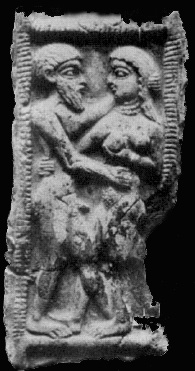
Most of the time when I hear reference to the Goddess Inanna, it's in relation to Her descent into the underworld. Many a ritual and teaching curriculum has been built around this story, and rightfully so. It is a powerful myth rich in symbolism. However we often forget that Inanna is primarily a goddess of love, as well as fertility. "The descent" is only one of the many stories told about her.

In Sumerian, Inanna literally means "Queen of Heaven". She was the first daughter of the Moon God, Inanna, and the Moon Goddess, Ningal. As a goddess of love and the heavens, it's not surprising that she is also associated with the planet Venus--or the Morning and Evening Star. In her guise of Queen of the Earth, she was  responsible for the fertility of the crops and humankind.

Lesser known than The Descent of Inanna, the hymn The Joy of Sumer tells of Inanna's descent from heaven and onto the earth to awaken the fertility of the plants and set into motion the annual cycle of life. This hymn, and the accompanying story, is particularly pertinent at this time of the year as it speaks to renewing the fertility of the earth. It is linked to the time of the year when the seeds are ready to be sown into the earth. In eastern Canada, that would be right about now, making it an interesting myth to work with around the time Beltaine.

Like many other myths associated with the fertility of the season, sex is involved. Inanna makes love with her lover, the King. Then Inanna and Dumuzi feast and celebrate among the people. Symbolically, this completes the marriage of heaven and earth, divine and mortal. It also reinforces the prosperity that Inanna offers the earth and her people.

Here is the Hymn:

The Joy of Sumer: The Sacred Marriage Rite 
The people of Sumer assemble in the palace,
The house which guides the land.
The king builds a throne for the queen of the palace.
He sits beside her on the throne.

In order to care for the life of all the lands,
The exact first day of the month is closely examines,
And on the day of the disappearance of the moon,
On the day of the sleeping of the moon,
The me are perfectly carried out
So that the New Year’s Day, the day of rites,
May be properly determined,
And a sleeping place be set up for Inanna.

The people cleanse the rushes with sweet-smelling cedar oil,
They arrange the rushes for the bed.
They spread a bridal sheet over the bed.
A bridal sheet to rejoice the heart,
A bridal sheet to sweeten the loins,
A bridal sheet for Inanna and Dumuzi.

The queen bathes her holy loins,
Inanna bathes for the holy loins of Dumuzi,
She washes herself with soap.
She sprinkles sweet-smelling cedar oil on the ground.

The king goes with lifted head to the holy loins,
Dumuzi goes with lifted head to the holy loins of Inanna.
He lies down beside her on the bed.
Tenderly he caresses her, murmuring words of love:
"O my holy jewel! O my wondrous Inanna!"

After he enters her holy vulva, causing the queen to rejoice,
After he enters her holy vulva, causing Inanna to rejoice,
Inanna holds him to her and murmurs:
"O Dumuzi, you are truly my love."

The king bids the people enter the great hall.
The people bring food offerings and bowls.
They burn juniper resin, perform laving rites,
And pile up sweet-smelling incense.

The king embraces his beloved bride,
Dumuzi embraces Inanna.
Inanna, seated on the royal throne, shines like daylight.
The king, like the sun, shines radiantly by her side.
 He arranges abundance, lushness, and plenty before her.
 He assembles the people of Sumer.

The musicians play for the queen:
They play the loud instrument which drowns out the southern storm,
They play the sweet algar-instrument, the ornament of the palace,
 They play the stringed instrument which brings joy to all people,
They play songs for Inanna to rejoice the heart.

The people spend the day in plenty.
The king stands before the assembly in great joy.
 He hails Inanna with the praises of the gods and the assembly:
 "Holy Priestess! Created with the heavens and earth,
 Inanna, First Daughter of the Moon, Lady of the Evening!
I sing your praises."

My Lady looks in sweet wonder from heaven.
The people of Sumer parade before the holy Inanna.
The Lady Who Ascends into the Heavens, Inanna is radiant.
Mighty, majestic, radiant, and ever youthful --
To you Inanna, I sing!

~As translated by Diane Wolkstein and Samual Noah Kramer, (C)1983

Friday, April 20, 2012

Hex Signs


Inspired by my friend Ryan and his blog A Changing Altar, I've decided to join the Pagan Blog Project. I anticipate posting every two weeks, so only once per letter of the alphabet. This Friday, the letter is H.

I think when many people hear the word "hex" they immediately thing of "curse". However, when used to refer to a type of folk art traditionally painted on barns and homes, hex takes on an entirely different meaning.

 "Hex signs" originate in Pennsylvania Dutch country and can be used magically or simply appreciated for their artistic beauty. Indeed, many historians and folklorists believe that the designs were originally nothing more than folk art brought over from Germany, but which later developed into a form of ethnic symbolism.  These days, many hex signs are associated with specific intents and carry quite a bit of magical power with them. But some are still just art. It's all in the intent, after all.

The term "hex sign" was probably picked up because of its sexiness. In a book published in 1924 about the Pennsylvania Dutch, many terms were used by local farmers to refer to the signs, including "blumme" (flowers) or "schtanne" (stars). However one farmer called them "Hexefoos" and that's what stuck.

There are a few classic designs for hex signs, many of which incorporate geometric shapes with symbols. Magically, the meaning of the hex is based on the shapes, colours and symbols used in its design. For example a six-pointed rosette chases away bad luck, an eight-pointed star invites good fortune and an eight-pointed star or "sun ray" with a circle at the center is a symbol for success. If you add rain drops and/or wheat to this design, the hex may mean a good weather for successful harvest, however if you add acorns to the design it may mean success with conception or with a new project.


Here are some traditional meanings for hex signs:
  • Rosettes: Luck (or chasing away bad luck)
  • Stars: Luck or success (or protection)
  • 4-pointed sun wheel: Warmth and fertility
  • Acorn: Fertility or "humble beginnings"
  • Dove: Peace or friendship
  • Heart: Love
  • Oak leaf: Strength and endurance
  • Raindrop: Good weather or abundance
  • Tulips:  Faith, hope and trust (or chastity)
  • Wheat: Abundance, prosperity (abundant crops)
 If you are creating your own hexes then I believe that you can use symbolism that is meaningful for you and that has some sort of universal or cultural associations around it. The same goes for colour and geometry. Like other forms of magic that involve creating something (such as a talisman), you will be drawing energy to the spell and starting to form it as you work out the design of your hex. While creating the design, really focus on the intent or purpose of the hex, including the specific symbols and how the symbolism will empower the hex. Afterwards, raise energy to give it more juice if you want to, but sometimes the simple act of purposeful and focused creation is enough.

Hexes can be drawn, painted, embroidered, knitted, carved, planted as a design in a garden, decorated into a cake, or made in any way that results in a visual symbol. It's a fun and powerful form of spellcraft.