Amanda's musings on earth-based spirituality, magic, North-American witchcraft, and contemporary Paganisms.
Friday, May 04, 2012
Inanna: Goddess of Love and Fertility
Today's post is brought to you by the letter "I" in the Pagan blog project. :)
Most of the time when I hear reference to the Goddess Inanna, it's in relation to Her descent into the underworld. Many a ritual and teaching curriculum has been built around this story, and rightfully so. It is a powerful myth rich in symbolism. However we often forget that Inanna is primarily a goddess of love, as well as fertility. "The descent" is only one of the many stories told about her.
In Sumerian, Inanna literally means "Queen of Heaven". She was the first daughter of the Moon God, Inanna, and the Moon Goddess, Ningal. As a goddess of love and the heavens, it's not surprising that she is also associated with the planet Venus--or the Morning and Evening Star. In her guise of Queen of the Earth, she was responsible for the fertility of the crops and humankind.
Lesser known than The Descent of Inanna, the hymn The Joy of Sumer tells of Inanna's descent from heaven and onto the earth to awaken the fertility of the plants and set into motion the annual cycle of life. This hymn, and the accompanying story, is particularly pertinent at this time of the year as it speaks to renewing the fertility of the earth. It is linked to the time of the year when the seeds are ready to be sown into the earth. In eastern Canada, that would be right about now, making it an interesting myth to work with around the time Beltaine.
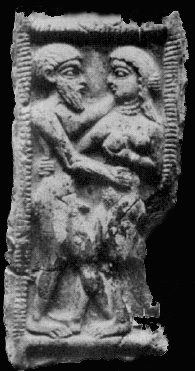
Like many other myths associated with the fertility of the season, sex is involved. Inanna makes love with her lover, the King. Then Inanna and Dumuzi feast and celebrate among the people. Symbolically, this completes the marriage of heaven and earth, divine and mortal. It also reinforces the prosperity that Inanna offers the earth and her people.
Here is the Hymn:
The Joy of Sumer: The Sacred Marriage Rite
The people of Sumer assemble in the palace,
The house which guides the land.
The king builds a throne for the queen of the palace.
He sits beside her on the throne.
In order to care for the life of all the lands,
The exact first day of the month is closely examines,
And on the day of the disappearance of the moon,
On the day of the sleeping of the moon,
The me are perfectly carried out
So that the New Year’s Day, the day of rites,
May be properly determined,
And a sleeping place be set up for Inanna.
The people cleanse the rushes with sweet-smelling cedar oil,
They arrange the rushes for the bed.
They spread a bridal sheet over the bed.
A bridal sheet to rejoice the heart,
A bridal sheet to sweeten the loins,
A bridal sheet for Inanna and Dumuzi.
The queen bathes her holy loins,
Inanna bathes for the holy loins of Dumuzi,
She washes herself with soap.
She sprinkles sweet-smelling cedar oil on the ground.
The king goes with lifted head to the holy loins,
Dumuzi goes with lifted head to the holy loins of Inanna.
He lies down beside her on the bed.
Tenderly he caresses her, murmuring words of love:
"O my holy jewel! O my wondrous Inanna!"
After he enters her holy vulva, causing the queen to rejoice,
After he enters her holy vulva, causing Inanna to rejoice,
Inanna holds him to her and murmurs:
"O Dumuzi, you are truly my love."
The king bids the people enter the great hall.
The people bring food offerings and bowls.
They burn juniper resin, perform laving rites,
And pile up sweet-smelling incense.
The king embraces his beloved bride,
Dumuzi embraces Inanna.
Inanna, seated on the royal throne, shines like daylight.
The king, like the sun, shines radiantly by her side.
He arranges abundance, lushness, and plenty before her.
He assembles the people of Sumer.
The musicians play for the queen:
They play the loud instrument which drowns out the southern storm,
They play the sweet algar-instrument, the ornament of the palace,
They play the stringed instrument which brings joy to all people,
They play songs for Inanna to rejoice the heart.
The people spend the day in plenty.
The king stands before the assembly in great joy.
He hails Inanna with the praises of the gods and the assembly:
"Holy Priestess! Created with the heavens and earth,
Inanna, First Daughter of the Moon, Lady of the Evening!
I sing your praises."
My Lady looks in sweet wonder from heaven.
The people of Sumer parade before the holy Inanna.
The Lady Who Ascends into the Heavens, Inanna is radiant.
Mighty, majestic, radiant, and ever youthful --
To you Inanna, I sing!
~As translated by Diane Wolkstein and Samual Noah Kramer, (C)1983
Tuesday, February 14, 2012
The Dance: Pas de Deux
Thursday, February 04, 2010
Pagans and Giving
Click here to take the survey: http://www.surveymonkey.com/s/FGXB29Z
And on the note of giving. A bunch of diviners and the MPRC have gotten together for a fundraiser this Sunday afternoon in the space above Le Melange Magique. There will be tarot reading and other forms of divination from the readers, and the MPRC will be selling off some of the doubles of books that have been donation. I think there may also be music and a bake table, but don't quote me on that. All funds raised are going to the red Cross for relief in Haiti. Hope to see you there. More information about Divine Relief is here.
Thursday, January 07, 2010
Winter Feast for the Soul
I love the quote from Rumi on the Winter Feast for the Soul Website:
What nine months in the womb does for the soul,I'm not so sure about early mornings--that I think is a personal predisposition--but 40 days of consistent, mindful spiritual practice will certainly grow awareness, whether we want it our not!
Forty early mornings will do for your growing awareness.
I think that one of the reasons that many people find daily practice so difficult is partly because of that growing awareness. It's scary. It can challenge our preconceptions. It can open us up to new ideas. It can shine a light on those dark places of our selves or our environment that we'd rather keep hidden. It's often easier to subconsciously find an excuse not to continue the practice, or to do it so inconsistently that we are effectively starting over each time, than it is to face our demons or our grandeur.
I have a daily spiritual practice. There are simple 'things' I do every day regardless of where I am or how I feel; and they form the foundation of my spiritual being, in a similar way to washing my face, brushing my hair and saying hello to my loved ones in the morning. On specific days, or if I'm working on a particular exercise or goal, I may add to this litany; but the foundation is essentially the same. In a similar way that a painter prepares her canvas, my foundational daily practice is the primer coat for deeper spiritual work.
I haven't decided yet how I'm going to approach the Winter Feast this year, Usually the winter months have me yearning to deepen my work with the Iron Pentacle; just as the emergence of spring calls forth the Pearl for me. What I do know is that I'm going to use these 40 days to stretch my edges and open to possibility.
Will you join me?
Monday, November 02, 2009
Paganism in the News
The Montreal Witches' Ball got a mention in the Montreal Mirror and in the Montreal Gazette. Not full articles to nice to see anyway. (Good job on publicity guys!) Sadly I wasn't able to go to the ball. I'm sure I missed a great event.
On Saturday, the New York Times ran a nice overview of how Samhain is less ghoul and quite a solemn celebration in a mainstream religion. It also mentions the upcoming American Academy of Religion (AAR) conference in Montreal this coming weekend.
Also Scarlet from CMS and Hobbes from the MPRC were interviewed on CKUT last week. You can listen to the interview here.
I'm sure I missed a few mentions. if you know of any, let me know.
Friday, June 13, 2008
Life is a Vibrating Vortex of Lust
"Well I got it standing on my farm in B.C. a few weeks ago. I was out there with the deafening sound of thousands of frogs fucking in my ponds, earthworms doing it beneath my feet, mason and bumble and honey bees fighting to stuff themselves into every flower in sight and I suddenly realized that I’m not farming, I’m presiding over one big giant orgy.
"I realized that every form of life on my farm is absolutely immersed in this incredible humming, buzzing, and vibrating vortex of lust. […]
"It’s not just like the bumper sticker that says, "organic farmers are more fertile." It’s more than that. You can’t possibly live and work in the midst of all this uncontrollable lust each and every day and night of your farm life and not become a part of it, not begin to embody it, attract it."
Mmmmm. Yes. More here: http://www.hopedance.org/new/issues/57/article2.html
Actually, I think his last point extends to more than the farm and nature's lust. We really can't live or spend a lot of time in any environment without beginning to embody it or have it change us in some way. The more intimate our connection with the environment, good or bad, the more potential it has to penetrate our being.
Wednesday, March 26, 2008
Our National Pagan Conference
This year the conference is close to home, in Ottawa. For those of us in Montreal, it may not be this close again for a while since the conference rotates cities and the organisers try to move it to completely different geographic regions each year.
For folks interesting in attending the conference--which I highly recommend--it costs $90 for three days of workshops participatory panels and other events over the Victoria long weekend in May. Accommodation at the University of Ottawa residence starts at $23 per person per night for a shared student room with 2 single beds (ie, $46 per night for the room). Dorm rooms may not be pretty but they certainly are a bargain for the budget conscious.
If past years are anything to go by, this conference brings together Canadian Pagans from across the country to celebrate our identities as both Canadian and Pagan, and to discuss issues relating to Canadian Paganism. For example last year, Prof. Lucie Dufresne gave a comprehensive presentation on how the law in Canada views Paganism, and how our laws rights and freedoms differ from those of our neighbours to the south. Very enlightening. Past conference have also discussed the legal how-tos of creating churches and performing handfastings in Canada. Who knows what this conference will hold.
The program is not final, but the conference is essentially a co-creative effort and you can see the discussions and proposals on the YahooGroup list at: http://groups.yahoo.com/group/Gaia_Gathering/
The conference also has an academic stream for pagan scholars, both those academic and amateur, as well as a music stream and a visual arts gallery displaying the work of our talented peers.
On March 11th the line-up looked like his:
Featured speakers talking about Pagan parenting.
Featured speaker talking about Pagan resource centers
Academic / Scholar's stream of presentations
Song and Chant share
Panels on:
Pagan parenting
Numbers and Visibility
Teachers and Mentors
Counselling skills
Pagan civil rights
Pagan businesses
Conflict resolution
Gender roles
Song as ritual tool
Druidry
For those of you who remember the Montreal conference in the fall: yes, some of the panels are similar. The format of the conference is also similar: moderated peer panels rather than speaker/audience.
You can get information about the conference and the registration form at http://www.gaigathering.ca
Tuesday, May 08, 2007
Canadian Wicca
It seems that most Canadian Gardnerian covens are not descended from Buckland, they are descended from British immigrants to Canada; and most Alexandrian lineage in Canada comes from one Alexandrian coven in Toronto in the 60s! This is fun!
Now onto looking at different traditions...
Friday, March 02, 2007
Dark Moon Magic
Dark moon magic is magic that's performed on the dark moon. This is the period (about three days) when the moon is not visible because it is in between the sun and the earth. Some folks believe that this is a very good time to do 'banishing' or 'destructive' magic, like getting rid of things we don't want. Also since it is that liminal time between death and rebirth, it can be a very powerful time to transformation magic that focusses on death and rebirth. Some people also believe that the dark moon is the ideal time to explore 'the mysteries' or the unseen. This makes it a good time to do 'inner' work and shadow work, or working with 'other worlds'.
Gail Wood's Sisters of the Dark Moon (Llewellyn 2001) works specifically with dark moon energies. It is intended to be used over a period of a year and offers meditations and rituals for 13 darkmoons. I find it is from a Wiccan perspective.
For inner or shadow work (and not necessarily dark moon work), Dark Moon Mysteries (Llewellyn 1999) and Apprentice to Power (Crossing Press, 2000) by Timothy Roderick are both excellent. They are also from a Wiccan persepctive. I also like The Mist-Filled Path by Frank MacEowan (New World, 2002), which offer a 'Celtic-Shamanic' perspective, with hints of eco-psychology influences, on inner-work. Plus there are a number of books on shadow-work from a Jungian perspective (the concept of the shadow, I believe, is actually Jungian). Owning Your Own Shadow by Robert Johnson (Harper 1993) is a slim book that discusses the concept of 'the shadow' in accessible terms. It's from a predominantly Christian perspective.
I don't recommend embarking on shadow work on your own, but these books can give you a bit of perspective on the concept. I'm not up on spellcrafting or ceremonial magick books, but I'd be surprised if there isn't anything out there that looks at the spellcasting or magic specifically from a lunar phase perspective. You might want to try looking at some books on biodynamic planting (planting with the moon phases). I suspect the underlying principles of why it is better to plant and prune at different moon phases will be similar to the underlying principles of spell casting by different moon phases; but don't quote me on that.
Thursday, September 14, 2006
In class we were talking about definitions of some words that come up pretty frequently in neo-paganism: witch, Wiccan, magic, witchcraft... You know the ones. My own definitions are pretty fluid. I never seem to quite manage to nail them down. How I define the words one day might be different days, weeks, months or years later as my own knowledge and understanding evolves.
Many definitions in the study and practice of religion, especially mystical traditions, are open to personal interpretation. Neo-paganism is no exception. In fact, I'd argue that finding consensus on lexical definitions in neo-paganism is probably more problematic than most religions because of the heterogeneity of beliefs under the neo-pagan umbrella, the general lack of formal structure, and its young age. Stipulative definitions are often much more helpful. Having said that, here are a few of my own. Your (and my) mileage may vary.
Religion: The expression of acknowledgment of the divine or something beyond 'physical reality,' usually incorporating a system of beliefs and practices relating to the sacred and uniting its adherents in some sense of unity or community.
Pagan: An umbrella term for folk religions and theistic nature religions.
Neo-Paganism: An umbrella term for a set of spiritual and religious traditions that incorporate the following set of beliefs: the world is holy/sacred and sacredness is imminent; a worldview that includes unseen realms or energies; religious tolerance; self-responsibility; right relationship with self, community and the sacred; personal relationship with the sacred; self-identification as a neo-pagan.
Wicca: An initiatory mystery tradition/religion with specific tenets of belief such as a belief in both a god and a goddess, reincarnation, and the natural law of threefold return.
Witch: (a) Primarily one who walks the edges, in-between, and liminal spaces, holding all possibilities within oneself. But also one who seeks to know his or her true self; who acknowledges and seeks to align with natural cycles, 'unseen' energies, and (often) the sacred or something beyond 'physical reality;' and who is willing to acknowledge and step into his or her own personal power. (b) Any one of the huge number of accepted lexical definitions of the word witch.
Magic(k): (a)The art of opening individual awareness at will to specific (or universal) consciousness, energies and patterns in order to effect some sort of transformation, usually one the 'material plane.' (b) The intentional manipulation of powerful symbols in order to produce predictable results within the psyches of the practitioners.
Witchcraft: (a) The practice of folk traditions that consciously work with consciousness, energies, patterns and symbols. (b) An ecstatic tradition usually employing magic that seeks to align an individual with natural cycles and energies, the self, and often the sacred or something beyond 'physical reality'.